Disclosure: This article contains Amazon affiliate links. If you buy through them, I may earn a commission at no extra cost to you. I purchased or arranged access to this product independently — it wasn’t provided for review. Prices change; check the listing for current figures.
The first thing that held my attention on the COWSAR Nugget Countertop Ice Maker was its shape: unusually narrow, but not shallow. That distinction matters more than the polished product photos suggest. You are trading a slice of counter width for a tall dispenser, a small ice basket, and a water tank that still needs hands-on attention. Automatic dispensing is genuinely useful in a shared kitchen; it just does not automate the less glamorous parts of owning an ice machine.
Table of Contents
Open Table of Contents
- COWSAR Nugget Countertop Ice Maker: Slim Body, Real Trade-Offs
- What 33 Pounds a Day Means With a 1.5-Pound Basket
- A 6.7-Inch Width Saves Counter Space Until You Measure Depth
- Automatic Dispensing Removes the Scoop, Not Every Mess
- Self-Cleaning Still Leaves You With Water and Scale
- Where Full-Basket Sensors and Melting Ice Can Interrupt the Routine
- COWSAR vs. GE Profile Opal 2.0 Ultra: Two Different Kinds of Convenience
- Who Should Skip the COWSAR—and Who Will Appreciate Its Shape
- Questions Worth Answering Before You Choose the Dispenser Model
- Does the COWSAR nugget ice maker need a water line?
- Does “measured dispensing” mean it weighs every serving?
- How much ice is available at once?
- Is the ice basket a freezer?
- Does self-cleaning remove limescale automatically?
- Can it fill water bottles as well as glasses?
- Is this model better than the GE Profile Opal 2.0 Ultra?
COWSAR Nugget Countertop Ice Maker: Slim Body, Real Trade-Offs
What 33 Pounds a Day Means With a 1.5-Pound Basket
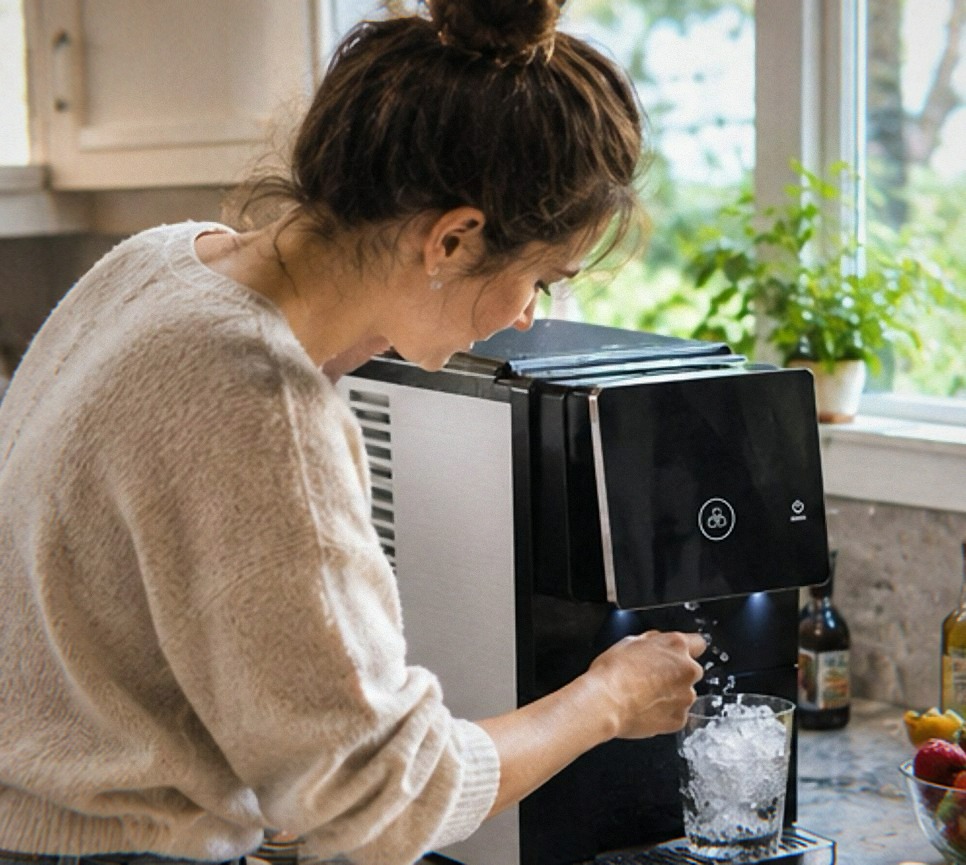
The COWSAR’s 33-pound daily figure is a production ceiling, not the amount of ice waiting in the machine. Its storage basket is much smaller, so reaching anything close to the daily total requires continuous operation and frequent removal or dispensing of ice.
📋 Spec-sourced: COWSAR’s product information rates this model at up to 33 pounds of nugget ice per 24 hours. The built-in water tank holds 1.8 liters, and the ice basket holds 1.5 pounds. When the basket reaches capacity, the Ice Full reminder stops production to prevent overflow, according to the manufacturer.
🔢 Derived: Dividing 33 by 24 gives an average of roughly 1.375 pounds per hour if the machine could sustain that rate around the clock. At that simple average, the listed basket capacity corresponds to a little over an hour of production. That is arithmetic based on the rated figures, not a measured basket-fill time; real cycles vary with room temperature, water temperature, sensor position, and how ice settles.
Why the full-basket stop matters more than the daily rating
An automatic stop is useful. It keeps the mechanism from forcing more ice into an occupied basket. It also means the appliance cannot be left alone all day with the expectation of producing 33 pounds unattended. Someone has to use the ice, move it, or redistribute it if the sensor sees a full area.
For ordinary drinks, that arrangement can be perfectly reasonable. A small basket turned over regularly is arguably more useful than a large pile sitting around and melting. For entertaining, you need a freezer container and a routine before guests arrive. Otherwise, the daily number creates expectations the basket was never designed to meet.
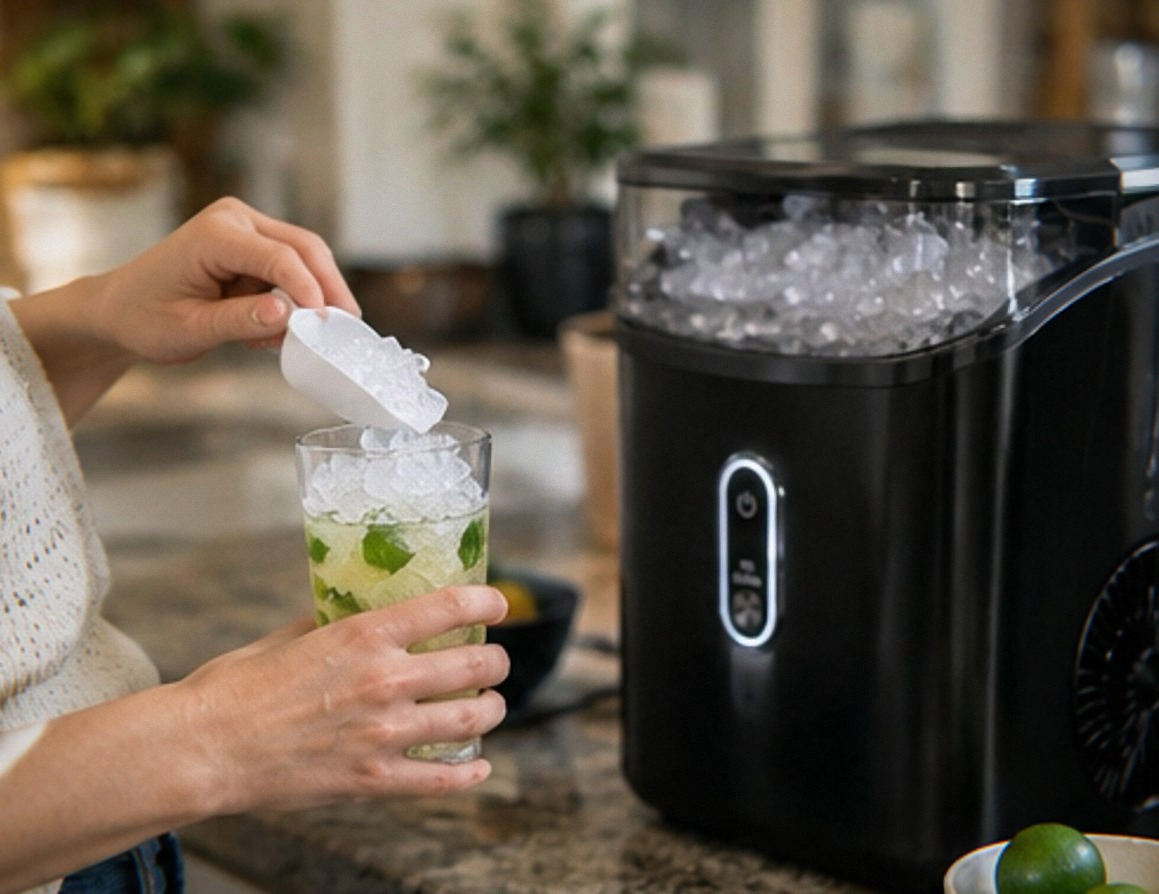
Nugget ice itself is made from compacted flakes rather than the solid cubes produced in a typical freezer tray. It is softer to chew and has more small surfaces and gaps. That makes it pleasant in soda, iced coffee, and water, but it can dilute a slow-sipped drink faster than a large, dense cube. The manufacturer’s description highlights soft, chewable pellet ice (📋 spec-sourced); it does not establish a fixed texture for every batch or storage condition.
A 6.7-Inch Width Saves Counter Space Until You Measure Depth
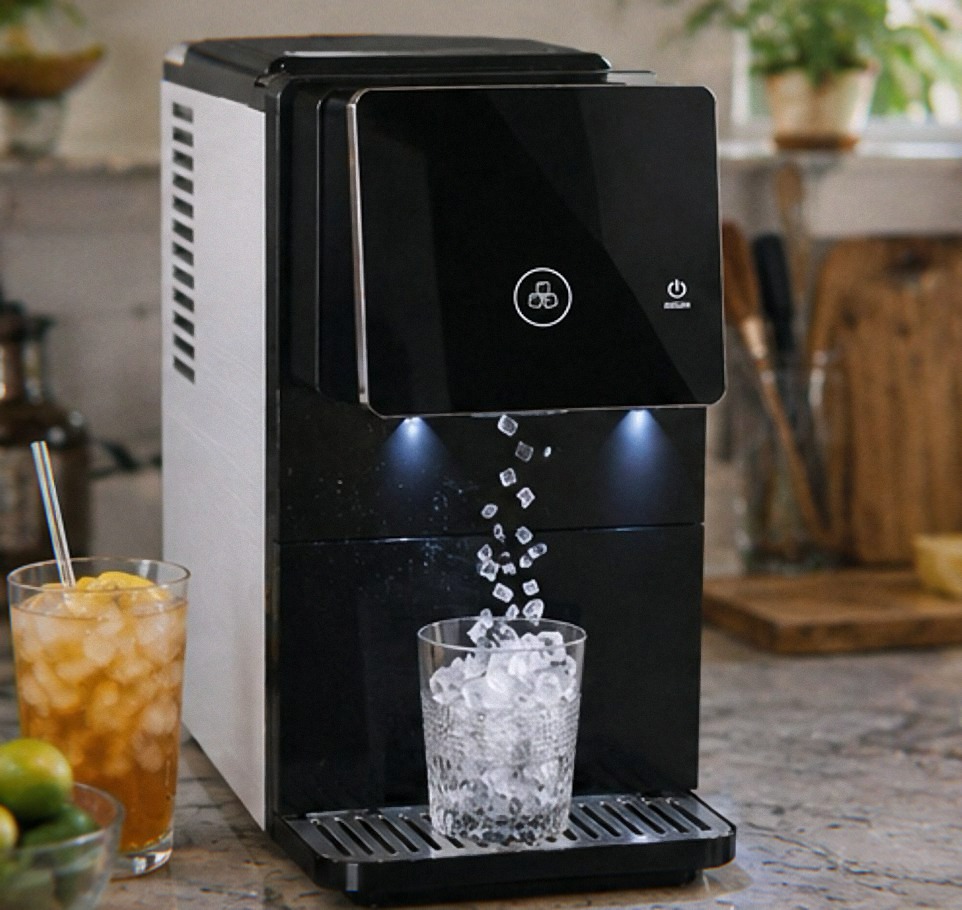
The narrow cabinet is the COWSAR’s clearest advantage over larger nugget-ice machines. It can fit into a strip of counter where a wider side-tank model would be impossible, but the depth and cup-dispensing area still need to work in your actual kitchen.
📋 Spec-sourced: The listed dimensions are 16.33 inches deep × 6.7 inches wide × 13.58 inches high. COWSAR describes the unit as suitable for a kitchen, office pantry, RV, or basement bar. The current product information does not provide a required ventilation-clearance diagram, so I would consult the manual rather than push it flush against walls or cabinetry.
Width is only one dimension. At more than 16 inches deep, the machine can occupy much of a standard countertop’s working zone. You also need room to place a cup under the dispenser, open whatever lid or access points the manual requires, add water, and drain the unit for cleaning. A narrow gap beside a refrigerator may fit the cabinet while making all of those tasks awkward.
“Portable” needs a practical definition
The manufacturer calls the machine portable, and the small width helps when moving it between rooms. Portable does not mean cordless, waterproof, or designed for use in a hot vehicle. It is an electric refrigeration appliance with a water reservoir. Keep it on a suitable level surface, follow any settling-time instructions after transport, and do not assume an RV storage bay is an acceptable operating environment just because the machine fits there.
The listed electrical rating is 230 watts (📋 spec-sourced, Amazon product details). That is not enough information to calculate an exact daily energy cost. A compressor and associated components cycle; ambient heat, production demand, and standby behavior all matter. Anyone estimating running cost should measure their own unit over representative use rather than multiplying 230 watts by 24 and calling that reality.
Automatic Dispensing Removes the Scoop, Not Every Mess
Automatic dispensing is the main reason to consider this COWSAR over a cheaper basket-and-scoop machine. It lets each person place a cup and request ice without putting a shared scoop—or their hands—into the storage area. In an office or family kitchen, that is a meaningful convenience.
The manufacturer describes “measured dispensing” and says the machine delivers ice directly into a glass at the touch of a button (📋 spec-sourced). The supplied information does not define the measurement in ounces, grams, dispensing time, or selectable portion levels. I would not interpret “measured” as a promise of an exact weight for every drink unless the current manual provides those settings and tolerances.
The hygiene benefit depends on the parts you cannot see
Avoiding a scoop reduces one contact point. It does not make the internal ice path sterile. Ice still sits in a storage area, moves through a dispensing mechanism, and passes an outlet that may be exposed to splashes from cups. Those surfaces need the cleaning routine specified by COWSAR.
A dispenser also changes the failure points. A simple basket lets you see and reach nearly all the ice. A chute or transfer mechanism can be less accessible, and wet nugget ice may bridge or stick as it melts and refreezes locally. ⚠️ Estimated/inferred: That is a general risk of compacted-flake ice and dispensing mechanisms, not evidence that this model jams at a known rate. I would check how the manual tells you to clear a blockage and whether doing so requires emptying the machine.
Cup size matters too. A short glass may leave enough drop distance for pieces to bounce; a tall bottle may not fit under the outlet. The supplied material does not give dispenser clearance or a compatible cup range, so I cannot responsibly provide a number. If your household mainly fills narrow-neck bottles, this is worth checking before purchase.
Self-Cleaning Still Leaves You With Water and Scale
The self-cleaning function is useful for circulating a cleaning solution through parts of the machine, but it does not remove the need to empty, rinse, drain, and wipe accessible surfaces. A cleaning cycle is a maintenance aid, not a maintenance exemption.
The product title and description identify self-cleaning as an included function (📋 spec-sourced). The box contains the ice maker and manual; no water filter or descaling kit is listed in the supplied package information. That means you should budget separately for any cleaner the manual permits rather than assuming one is included.
The 1.8-liter tank is a refill commitment
A built-in tank keeps the footprint simple and avoids a side attachment. It also means frequent users need to watch the water level and refill the internal reservoir. There is no permanent water-line requirement in the supplied information; filling is manual.
🔢 Derived: A 1.8-liter tank is approximately 60.9 US fluid ounces, using 1 liter = 33.814 US fluid ounces. That conversion does not translate neatly into a fixed number of drinks. Recirculated meltwater, ice left in the basket, serving size, and cleaning losses all change the result.
Hard water adds another obligation. Minerals in water can form deposits on surfaces exposed to repeated wetting, cooling, and evaporation. Filtering water may improve taste and reduce some contaminants, but not every pitcher filter removes hardness. Bottled water is not automatically low-mineral either; its mineral content varies.
⚠️ Estimated/inferred: Based on how similar small water-contact appliances age, I would expect seals, drain plugs, and frequently handled tank components to benefit from regular inspection. I cannot give a credible replacement timeline for this model from the available evidence. Rather than wait for a leak or an unusual pump sound, I would check the drain area and accessible seals whenever the unit is cleaned.
Use the cleaner and dilution specified in the current manual. Do not pour in an arbitrary bleach or vinegar mixture because it worked in a coffee maker; materials, rinsing requirements, and food-contact paths differ. Also drain the machine where water can be controlled. An owner comment on the supplied page mentioned positioning a unit near a sink for draining, which is practical advice, but it is not a substitute for the model-specific instructions.
Where Full-Basket Sensors and Melting Ice Can Interrupt the Routine
A full-basket sensor is supposed to stop production before overflow, but any such system depends on where ice accumulates. If nuggets pile near the sensing area while space remains elsewhere, production may stop before the basket is uniformly full. That is a behavior to observe, not a defect I can quantify for every unit.
The supplied Amazon page combines customer feedback from multiple capacities and model variants, including bullet-ice versions. Those reports mention sensor interruptions, noise changes, water-level alerts, and durability problems, but they cannot be treated as measured evidence for this specific 33-pound nugget dispenser configuration. I would not import their failure timelines into this article.
That does not make the concerns irrelevant. It means the sensible response is targeted inspection rather than a invented failure percentage.
What to watch during the return window
Watch whether the basket fills evenly and whether production restarts after ice is dispensed. Check that adding water clears a low-water condition as the manual describes. Listen for a new persistent whine or grinding sound rather than trying to decide whether the machine matches an unsupported “quiet” label. COWSAR uses quiet operation in its marketing (📋 spec-sourced), but the supplied page gives no decibel measurement, test distance, or room conditions.
Ice melting is not itself evidence of a broken machine. Countertop ice makers are not automatically freezer-storage appliances, and the supplied material does not claim that this basket keeps ice frozen indefinitely. Meltwater can be reused by the system. If you need hard, stored nuggets later, move them to a freezer; expect some clumping when wet surfaces freeze together.
⚠️ Estimated/inferred: If output changes at the same time as a new sound, repeated sensor alert, or visible water leak, I would stop troubleshooting by guesswork and document the behavior. Video the indicator, water level, and dispensing cycle. Keep the serial details and support correspondence. Do not open sealed refrigeration components or improvise an internal repair.
At capture time, the order area of the supplied page showed free 30-day refund/replacement terms for that purchase context (📋 spec-sourced). Seller and order terms can change, so verify the actual policy at checkout. A protection plan was also offered, but its price alone tells you nothing about whether its exclusions and claims process are worthwhile.
COWSAR vs. GE Profile Opal 2.0 Ultra: Two Different Kinds of Convenience
The COWSAR is the narrower, dispenser-oriented choice; the GE Profile Opal 2.0 Ultra is the larger, higher-capacity package with a removable side tank. Neither is universally better. The decision is whether you value cup dispensing and a slim cabinet more than a larger ice basket and reduced refilling.
| Specification | COWSAR 33-lb nugget dispenser | GE Profile Opal 2.0 Ultra with side tank |
|---|---|---|
| Manufacturer’s daily production | Up to 33 lb | Up to 38 lb |
| Ice storage | 1.5 lb basket | 3 lb bin |
| Water arrangement | Built-in 1.8 L tank | Removable .75-gal side tank |
| Listed dimensions | 16.33 D × 6.7 W × 13.58 H in | 17.5 D × 13.43 W × 16.5 H in |
| Electrical rating shown | 230 W | 360 W |
| Ice access | Automatic dispenser | Bin and included scoop |
| Smart control | Not established in supplied material | SmartHQ app and supported voice control |
📋 Spec-sourced: All figures above come from the two manufacturers’ supplied Amazon product information. They are not results from a controlled side-by-side test.
🔢 Derived: The COWSAR is 6.73 inches narrower by the listed widths (13.43 − 6.7). That is substantial. The GE’s side tank holds 0.75 gallon, approximately 2.84 liters, compared with the COWSAR’s 1.8-liter built-in tank; the conversion uses 1 US gallon = 3.785 liters. This does not prove how long either machine runs between refills because consumption and recirculation vary.
The captured COWSAR page showed $269.96 for this configuration, while the previously captured GE side-tank configuration showed $499 (📋 spec-sourced, historical page snapshots). Those prices are not guaranteed today. The comparison is useful mainly for understanding the size of the premium, not for publishing a permanent deal claim.
I go into the GE’s larger bin, side tank, upkeep, and noise considerations in my GE Profile Opal 2.0 Ultra review. If you are torn between the two, that article is the more relevant next read than another generic list of ice makers.
My own leaning is simple. In a tight kitchen or shared drinks station, the COWSAR’s width and dispenser make sense. For a household that values a bigger ready-to-scoop supply and already has the counter space, the GE package is easier to justify—provided its cleaning routine is acceptable.
Who Should Skip the COWSAR—and Who Will Appreciate Its Shape
Skip the COWSAR if you want a large reserve of ice sitting ready for a gathering, need exact programmable portion weights, or dislike draining and cleaning a small water appliance. The product material does not establish those portion controls, and the 1.5-pound basket is intentionally modest.
I would also hesitate if your primary goal is filling tall bottles all day. Without a documented outlet-clearance measurement and bottle compatibility, the automatic dispenser may be less convenient than an open bin and scoop. Similarly, anyone who needs frozen storage should plan on using a separate freezer rather than expecting the basket to do that job.
The best fit is a smaller household or office that makes several drinks across the day and values a narrow footprint. Automatic dispensing is useful where many hands would otherwise share a scoop. The full-basket stop is less troublesome when ice is consumed steadily rather than stockpiled.
At 33 pounds per day, the rated production is ample for many normal routines (📋 spec-sourced, manufacturer maximum under continuous operation). The smaller basket is the limiting factor only if your routine involves long unattended stretches or sudden demand from a crowd.
If that sounds like your kitchen, you can check the COWSAR Nugget Countertop Ice Maker with automatic dispensing on Amazon. Confirm that the selected set is 33 lbs-Nugget, since the page contains other capacities and ice styles.
Questions Worth Answering Before You Choose the Dispenser Model
Does the COWSAR nugget ice maker need a water line?
The supplied information describes a built-in 1.8-liter water tank and manual filling. No permanent water-line connection is listed as required. You still need a suitable power supply, a level operating position, and a practical way to drain and clean the reservoir.
Does “measured dispensing” mean it weighs every serving?
Not necessarily. COWSAR uses that term in the product description, but the supplied material does not specify weight, volume, portion presets, or accuracy. Treat it as automatic dispensing unless the manual documents actual measurement controls.
How much ice is available at once?
The listed basket capacity is 1.5 pounds. The machine can continue making ice after some is dispensed, up to its rated daily production, but it stops when the full-basket condition is detected. For a party, store surplus ice in a freezer ahead of time.
Is the ice basket a freezer?
The supplied product information does not claim indefinite frozen storage. Expect ice to melt over time and meltwater to be reused. Transfer nuggets to a freezer for longer storage, and break apart clumps as needed before serving.
Does self-cleaning remove limescale automatically?
A self-cleaning cycle should not be treated as proof that every deposit or food-contact surface is handled without manual work. Follow COWSAR’s instructions for cleaner, rinsing, draining, and wiping. In hard-water conditions, inspect the machine rather than relying only on a button or reminder.
Can it fill water bottles as well as glasses?
That depends on the space beneath the dispenser and the bottle opening. The supplied page does not provide an outlet-clearance specification. If bottle filling is your main use, verify that detail before choosing a dispenser over an open basket.
Is this model better than the GE Profile Opal 2.0 Ultra?
It is better suited to narrow counters and people who prefer automatic dispensing. The GE offers a larger listed ice bin and side tank, with a wider cabinet and a higher historical page price. The right choice depends on available space and whether you use ice continuously or want a larger ready supply.
You can view the current COWSAR 33-lb nugget dispenser offer and check the selected variant, current seller, return terms, and price before deciding.