Disclosure: This article contains Amazon affiliate links. If you buy through them, I may earn a commission at no extra cost to you. I purchased or arranged access to this product independently — it wasn’t provided for review. Prices change; check the listing for current figures.
The ice bin is the part of the GE Profile Opal 2.0 Ultra I kept thinking about after the novelty of chewable ice wore off. It is generous for a countertop machine, but it is not a freezer, and that single fact changes how the whole appliance fits into a day. The side tank reduces trips to the faucet; it does not reduce the need to deal with melting ice, standing water, or cleaning. I like the ice. I am much less charmed by everything the machine asks in return.
Table of Contents
Open Table of Contents
- GE Profile Opal 2.0 Ultra Nugget Ice Maker: Great Ice, Daily Upkeep
- What 38 Pounds a Day Looks Like When the Bin Holds Three
- The .75-Gallon Tank Saves Refills, Not Counter Space
- Nugget Ice Melts Back Into the System—by Design
- The Cleaning Schedule Is Part of the Purchase
- Where Squealing, Dripping, and Stalled Production Deserve Attention
- Opal 2.0 Ultra vs. Opal Without the Side Tank vs. Silonn
- Who Should Skip This Machine—and Who Will Put Up With It
- Questions I Would Want Answered Before Spending This Much
- Does the Opal 2.0 Ultra need a water line?
- Does the ice bin keep nuggets frozen indefinitely?
- Is 38 pounds of ice enough for a party?
- How often does it need descaling?
- Are the filter and descaling powder reusable?
- Is the Wi-Fi feature essential?
- Is it worth buying instead of the version without the tank?
GE Profile Opal 2.0 Ultra Nugget Ice Maker: Great Ice, Daily Upkeep
What 38 Pounds a Day Looks Like When the Bin Holds Three
The Opal 2.0 Ultra can make a large amount of ice over a full day, but it cannot store that amount. Its daily rating describes continuous production under suitable conditions, not a bin that magically fills with 38 pounds while you are at work.
📋 Spec-sourced: GE’s product information rates the machine at up to 38 pounds per day, or 1.6 pounds per hour at 70°F ambient temperature with 60°F water. The listing also says the first batch can arrive in 10 minutes or less. Those are manufacturer’s figures, not measurements I took with a scale and stopwatch. The ice bin holds 3 pounds, according to the same product information.
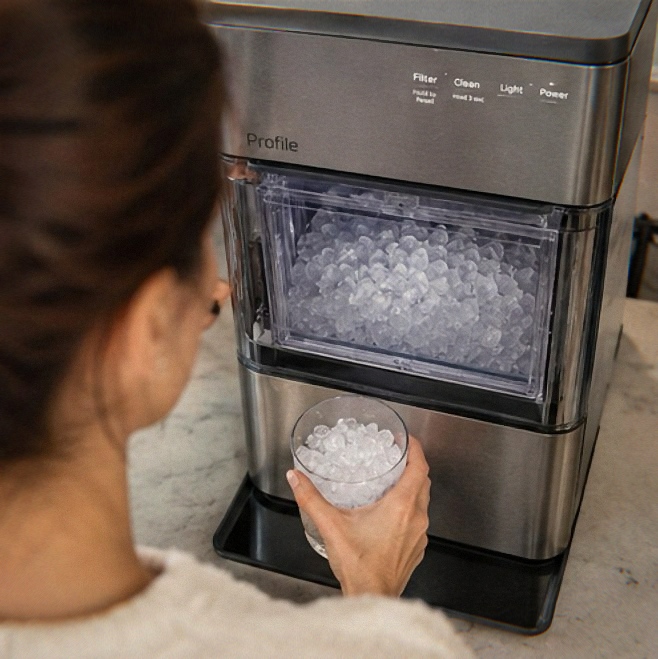 🔢 Derived: Dividing 38 by 24 gives roughly 1.58 pounds per hour, which lines up with GE’s separate hourly figure. That consistency is useful, but it also reveals the assumption behind the headline: the machine has to keep running, and the bin has to be emptied or used regularly. If the bin reaches its capacity and production pauses, your household will not collect the theoretical daily total. I would treat 38 pounds as a ceiling for continuous operation, not a realistic promise for an ordinary kitchen routine.
The bin changes the meaning of “high capacity”
For a family making drinks through the afternoon, the arrangement makes sense. Ice is produced, scooped, replaced, and produced again. For a party, you need to decide where the surplus goes beforehand. A freezer-safe container works, although nuggets stored together may clump as their wet surfaces freeze; that is normal behavior for this style of ice rather than a special Opal defect.
The machine’s stated electrical rating is 360 watts (📋 spec-sourced, from the Amazon product details). That is an input rating, not proof that it draws exactly 360 watts every minute or a basis for a precise monthly electricity bill. Duty cycle, room temperature, water temperature, and compressor behavior all matter. Anyone selling you a suspiciously exact running-cost figure without measuring those variables is guessing with extra decimals.
I would not buy this model for the daily number alone. The more practical advantage is that a household does not have to wait very long between small batches. That distinction sounds minor until the bin is empty just before dinner.
The .75-Gallon Tank Saves Refills, Not Counter Space
The removable side tank is worth having if several people use the machine every day. It reduces how often you interrupt production to add water, and it removes the need for a permanent plumbing connection. It also makes an already substantial countertop appliance wider.
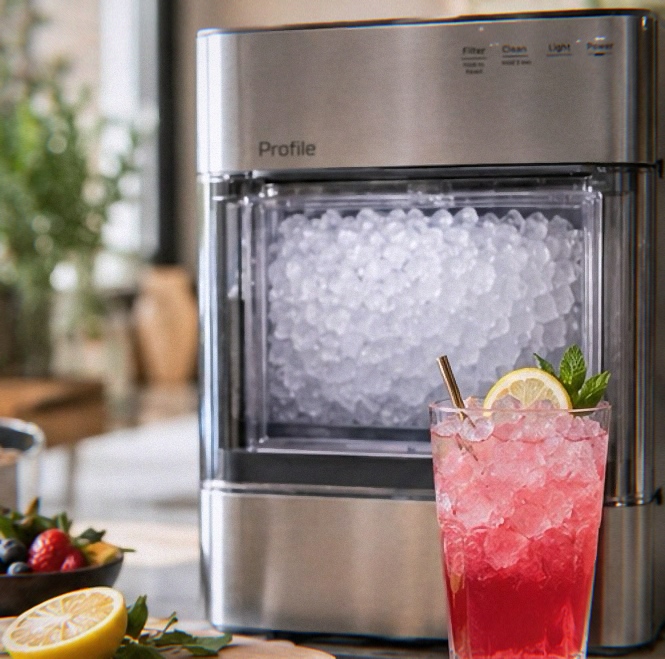 📋 Spec-sourced: The included tank holds 0.75 gallon. With the tank attached, GE gives the overall dimensions as 17.5 inches deep, 13.43 inches wide, and 16.5 inches high. The machine is filled manually; no fixed water line is required.
That width deserves a tape measure, not a glance at a product photo. The depth is often the bigger annoyance because the unit can occupy the useful front-to-back zone where small appliances normally live. You also need practical access to remove the tank, pull out the bin, and scoop ice. A nominal fit under cabinets does not automatically make the location convenient.
Why I would still choose the tank for a shared kitchen
A tank is most valuable when more than one person is consuming ice and nobody wants to own the refill job. It is detachable for filling and cleaning, which is a better arrangement than lifting the entire machine toward a sink. The trade is simple: more water readiness on one side, less open counter on the other.
The tank does not make the appliance portable in any carefree sense. This is a refrigerated machine with water moving through an internal system. I would not treat it as something to carry outside for a weekend gathering unless GE explicitly permits the conditions and you can keep it level, protected, and properly drained. The supplied page does not establish outdoor suitability, so I would not assume it.
🔢 Derived: A 0.75-gallon tank contains about 96 US fluid ounces of water because one US gallon is 128 fluid ounces. That is a unit conversion, not an ice-yield estimate. Ice production also draws from the machine’s internal reservoir and recirculates meltwater, so converting tank volume directly into a precise number of drinks would be false precision.
Nugget Ice Melts Back Into the System—by Design
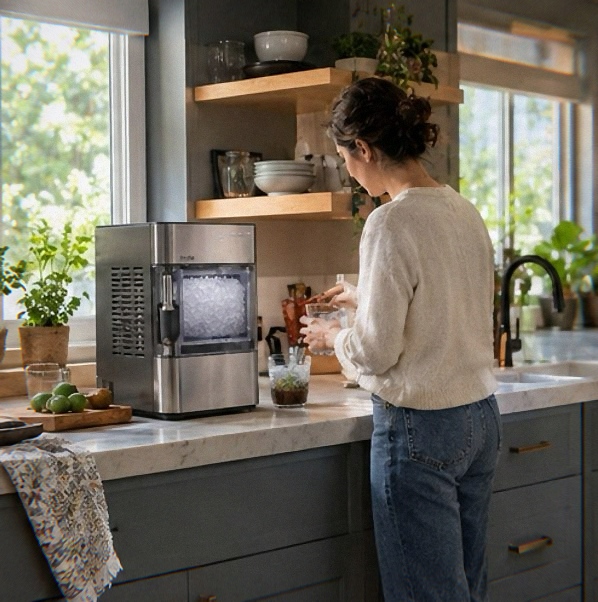
The Opal makes nugget ice by compacting ice flakes into soft, chewable pieces rather than producing the hard, clear cubes associated with a freezer tray. Its bin is chilled by the ice-making environment but is not a long-term freezer compartment. Melted water returns to the system for subsequent batches.
That recirculation is efficient, but it explains why “it makes ice” and “it stores ice” are separate jobs. Leave the bin alone and the texture changes. Some ice melts, some remains, and new production continues as conditions allow. If you want a supply of hard, separately frozen nuggets for later, transfer them to a freezer.
Soft ice is not automatically better in every drink
Nugget ice has more small gaps and surfaces than a large cube. It is pleasant to chew and quickly chills a drink, but it also dilutes some drinks faster than a dense cube would. I prefer it in soda, iced tea, and water. For a spirit-forward cocktail that I want to sip slowly, I would rather have one large cube and keep the nuggets for another glass.
The product description calls the ice soft, chewable, and crunchy (📋 spec-sourced, manufacturer description). Texture varies with how long ice sits and whether it has been transferred to a freezer, so I would not expect every scoop to feel identical. That is not a flaw unique to this machine; it comes with the category.
There is an odd consequence here. People who love nugget ice often use more of it, which makes the side tank more useful and the cleaning routine more important. The feature that makes the appliance enjoyable also keeps its water system busy.
The Cleaning Schedule Is Part of the Purchase
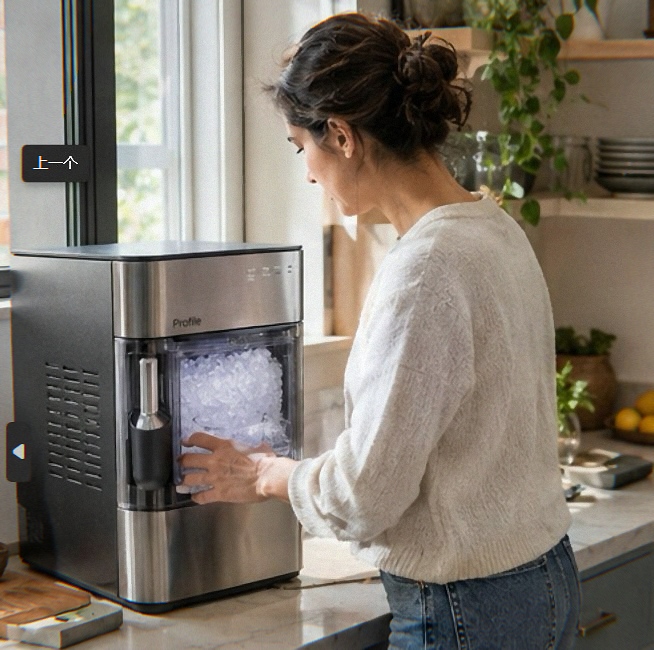
This is not an appliance to fill once and ignore. GE’s own page instructs owners to clean the Opal once per week and descale every two to three weeks (📋 spec-sourced, manufacturer guidance on the supplied listing). That schedule is the strongest argument against buying on ice texture alone.
The included scale-inhibiting filter is intended to reduce scale solidification and reduce bad flavors, chlorine, and VOCs in the water, according to GE. The package also includes one descaling-powder packet, a reusable air filter, a stainless-steel scoop, and a scoop holder (📋 spec-sourced, product description and accessory list). Replacement filter model P4INKFILTR is sold separately.
Hard water changes the ownership equation
Mineral scale forms because dissolved minerals come out of solution as water is heated, cooled, or evaporates; an ice machine’s wet, temperature-cycling interior is a plausible place for deposits to accumulate. The included filter may extend the interval between descaling jobs, but “scale inhibiting” does not mean “scale eliminating.”
⚠️ Estimated/inferred: Based on how similar water-contact appliances behave, I would expect local water hardness, daily runtime, and cleaning habits to matter more than a universal calendar. I cannot give you a reliable filter-life or component-life timeline from this material. In a hard-water home, I would inspect the water path and follow GE’s water-quality and maintenance instructions rather than waiting for noise or reduced output to announce a problem.
Some owners use filtered or reverse-osmosis water hoping to simplify maintenance. That may reduce incoming mineral load, but it does not make the food-contact surfaces self-cleaning. It also does not justify ignoring a descaling alert without checking the manual. A reminder is not a diagnosis of actual scale; it is a prompt to inspect and maintain the machine properly.
What actually needs your attention
The removable tank, bin, scoop, and accessible water-contact areas need regular cleaning. The reusable air filter should not become a forgotten dust mat. I would also pay attention to moisture around the bin and tank connection, because a small amount of water on a dark countertop is easy to miss.
⚠️ Estimated/inferred: Silicone seals and plastic water-path components can age with heat, mineral exposure, and cleaning chemicals, but I have not established a model-specific failure timeline. I would check seals and tank seating whenever cleaning rather than promise that a part will last a particular number of months. Use only cleaning agents and dilution methods permitted by the current GE manual; improvised bleach or vinegar routines can create compatibility and rinsing problems.
The maintenance is manageable if you accept it before purchase. It is miserable if you thought “self-cleaning” meant the machine would take care of itself.
Where Squealing, Dripping, and Stalled Production Deserve Attention
Normal refrigeration and ice-making sounds are expected; a new, persistent squeal accompanied by reduced output is not something I would dismiss as the machine’s personality. The supplied product page says operating sounds are similar to a refrigerator ice maker (📋 spec-sourced, manufacturer statement), but it does not provide a measured decibel figure. I will not invent one.
User reports on the captured page describe squealing, water dripping from the tilted bin, water-level sensor trouble, and machines that stopped producing ice. These are individual reports, not a measured failure rate. They are still useful because they identify what to check while a return or warranty path is straightforward.
What to check early
Listen for a change from the normal cycling sound, especially a high-pitched noise that persists. Watch whether production falls at the same time. Check that the tank is seated as the manual directs and that air is not being pulled into the water path. One detailed owner account on the supplied page described releasing trapped air from the side-tank connection, but that is one person’s diagnosis—not an established universal repair.
Pull the bin out over a sink or towel until you understand how meltwater behaves on your unit. If water escapes during ordinary use, note when it happens and whether the tank connection, bin position, or draining routine is involved. Do not open sealed components or attempt a pump repair on a new appliance.
I would also document any early fault with video, the serial information, and support correspondence. The Amazon page shown in the source offered a 30-day refund/replacement window at capture time (📋 spec-sourced, offer shown for that order context); return terms can vary by seller and order. The page says a manufacturer’s warranty can be requested from customer service, but it does not spell out the full warranty duration or conditions. Confirm those before relying on them.
A replacement can solve a faulty unit. It does not make repeated troubleshooting, draining, packing, and waiting free. That is the uncomfortable part of buying a complicated appliance for a simple pleasure.
Opal 2.0 Ultra vs. Opal Without the Side Tank vs. Silonn
The closest sensible alternative is the Opal 2.0 Ultra without the side tank: it keeps the same basic nugget-ice proposition in a narrower footprint. A lower-priced Silonn model makes sense if budget matters more than matching GE’s accessory bundle and exact capacity. Neither alternative removes the basic cleaning responsibilities of a wet ice-making system.
| Model | What the captured listing specified | Where it makes more sense |
|---|---|---|
| GE Profile Opal 2.0 Ultra with .75-gal tank | 38 lb/day; 3-lb bin; 13.43 in wide; side tank, filter, descaling packet, scoop | Frequent shared use where fewer refills justify the width |
| GE Profile Opal 2.0 Ultra without side tank | 17.5 in D × 10.5 in W × 16.5 in H; no side tank | One- or two-person kitchens where counter width is scarce |
| Silonn Nugget Ice Maker Countertop with app/voice control | 44 lb/day in the captured sponsored listing | Buyers prioritizing a lower displayed purchase price over the GE package |
📋 Spec-sourced: At the time this source page was captured, the reviewed Opal configuration showed $499, the no-side-tank Opal showed $449, and that Silonn listing showed a limited-time $249.96. These are historical snapshots, not current-price guarantees. Specifications and prices for other sellers should be checked on their own listings before purchase.
The no-tank Opal is the cleaner comparison because you are not juggling unrelated claims about UV systems, touchless dispensers, or unusually large production numbers. You give up about 2.93 inches of listed width by choosing it (🔢 derived: 13.43 minus 10.5), and you accept more frequent refills. For a small household, that is often the better bargain.
The Silonn’s higher advertised daily output does not automatically make it better. Bin capacity, operating conditions, ice texture, support, cleaning access, and long-term reliability all affect ownership. The supplied material does not provide enough like-for-like testing to declare a winner on those points.
Who Should Skip This Machine—and Who Will Put Up With It
Skip the Opal 2.0 Ultra if you need frozen ice storage, dislike weekly cleaning, or have only a narrow appliance gap. It is also a poor fit for an occasional user who wants a bag of party ice a few times a year; freezer ice or a bag from the store is much less trouble.
I would be cautious in an open-plan home where unexpected motor noise would be irritating, particularly if the machine will run overnight. Scheduling through SmartHQ may help limit when it operates, but it does not make a problematic squeal acceptable. Likewise, smart control is useful for schedules, maintenance alerts, software updates, and accessory ordering (📋 spec-sourced, GE product information); it is not a reason to buy the machine if the core ice-and-maintenance arrangement already sounds annoying.
The right buyer is narrower than the marketing suggests: a household that genuinely loves nugget ice, uses it most days, has measured the counter, and will clean the water system without resentment. For that household, the side tank and three-pound bin are practical rather than decorative. The ice is the reward. The routine is the cost.
If that sounds like your kitchen, you can check the GE Profile Opal 2.0 Ultra with the side tank and accessory kit on Amazon. Verify the exact configuration, seller, return terms, and current price before ordering.
Questions I Would Want Answered Before Spending This Much
Does the Opal 2.0 Ultra need a water line?
No. The supplied product information says to plug it in and fill the removable tank with water. There is no permanent water-line installation required. You do need a suitable electrical outlet and a location where the tank, bin, and cleaning points remain accessible.
Does the ice bin keep nuggets frozen indefinitely?
No. It is an ice-making bin, not a freezer. Ice melts and water is recirculated into later batches. Transfer ice to a freezer if you want to store it separately, and expect some clumping when wet nuggets freeze together.
Is 38 pounds of ice enough for a party?
Potentially, but only with planning. The rating assumes continuous operation, while the bin holds three pounds. Empty the bin into freezer storage ahead of the event and leave time for production; do not expect 38 pounds to be waiting inside at once.
How often does it need descaling?
GE’s supplied page says to clean weekly and descale every two to three weeks. Water conditions and usage can affect actual deposits, so inspect the machine and follow the current manual rather than treating that interval as permission to ignore changes in taste, noise, or output.
Are the filter and descaling powder reusable?
The included scale-inhibiting filter is a replaceable water filter, not a permanent solution; GE identifies replacement model P4INKFILTR. One descaling-powder packet is included, so future descaling supplies are an ongoing purchase. The separate air filter is described as reusable.
Is the Wi-Fi feature essential?
No. The touch display handles basic power, status, cleaning-cycle, and connection functions. Wi-Fi adds scheduling, alerts, updates, and voice integration through supported SmartHQ, Amazon, and Google services. If you only want ice and will never schedule production, pay for the ice system—not the app icon.
Is it worth buying instead of the version without the tank?
For one or two light users, I would seriously consider the narrower no-tank version. For a family that empties the bin repeatedly, the .75-gallon tank is the feature I would choose. You can compare the current Opal 2.0 Ultra side-tank offer here, then decide whether fewer refills are worth the extra counter width for your routine.