Disclosure: This article contains Amazon affiliate links. If you buy through them, I may earn a commission at no extra cost to you. I purchased or arranged access to this product independently — it wasn’t provided for review. Prices change; check the listing for current figures.
The EUHOMY Nugget Ice Maker makes the soft, chewable pellets that freezer trays never quite replicate, and it starts dropping ice in roughly six to eight minutes. That speed is useful, but the six-minute figure does not mean a full basket appears while you rinse a glass. This machine suits someone who will run it regularly and stay on top of cleaning; it is a poor shortcut for anyone expecting a silent, refrigerated ice supply.
What This Review Covers
- Six Minutes Means First Ice, Not a Full Basket
- Why the 1.8 lb Basket Changes Daily Use
- Will the EUHOMY Fit Beside a Coffee Maker?
- What Chewable Nugget Ice Does to Drinks
- Where the Handle Helps—and Where RV Use Gets Awkward
- The Removable Lid Matters More Than Auto-Cleaning
- Hard Water Can Ruin the Easy Ownership Plan
- Is Under 45 dB Quiet Enough for an Open Kitchen?
- Who Should Buy the EUHOMY—and Who Should Skip It
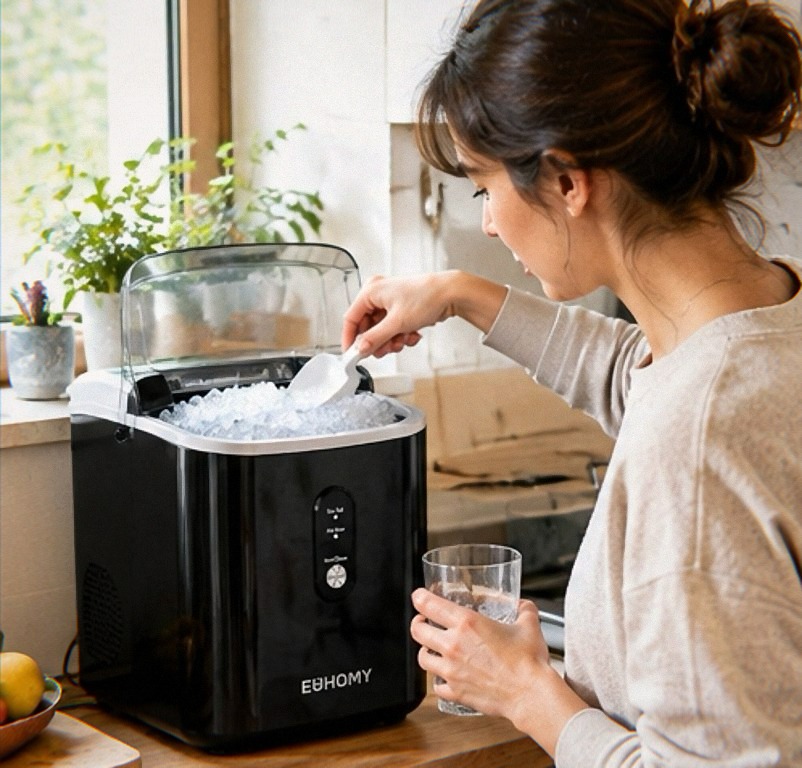
Six Minutes Means First Ice, Not a Full Basket
A six-minute start is genuinely handy when you decide on iced coffee after breakfast rather than planning drinks the night before. Add water, press the control, and the refrigeration system begins forming flakes that are compressed into small pellets. There is no tray to twist and no freezer door standing open.
The timing needs context. Six minutes is the wait for the cycle to begin yielding ice, not the time required to fill the removable basket. A small first handful can disappear into one tumbler, leaving you waiting for the next batch while your coffee warms. For two people making drinks at the same time, starting the machine before preparing everything else makes far more sense than turning it on after the glasses are filled.
The 34 lb Daily Figure Is a Production Ceiling
The maximum output is 34 pounds over 24 hours under suitable operating conditions. Spread evenly, that is about 1.42 pounds per hour before accounting for pauses, an already-full basket, or the time you spend refilling water. It is a continuous-production figure, not a promise that 34 pounds of ice will be waiting inside the appliance.
That distinction matters at a party. A steady household supply is plausible if someone empties the basket and keeps the reservoir fed. Leaving the machine untouched all afternoon and expecting an enormous stockpile is not how this format works. Warm room air and warm refill water also give the refrigeration system more heat to remove, so a kitchen near a hot oven is hardly the ideal place to chase maximum output.
Why the 1.8 lb Basket Changes Daily Use
The basket holds up to 1.8 pounds, roughly 0.82 kilograms. That is useful for a few drinks, but it is only a small fraction of the daily production ceiling. Once the ice reaches the sensor’s detection point, the ICE FULL alert asks you to intervene. Emptying the pellets into a freezer container creates space for another run and gives you a reserve for later.
There is a catch: this basket is for collecting fresh ice, not storing it like a freezer bin. The refrigeration hardware is there to make ice, and the basket area is not a second deep-freeze compartment. Pellets sitting inside will gradually soften and melt, with meltwater returning through the machine’s water path where the design allows it. For drinks over the next hour, that arrangement is fine. For tomorrow’s cooler, move the ice to an actual freezer.
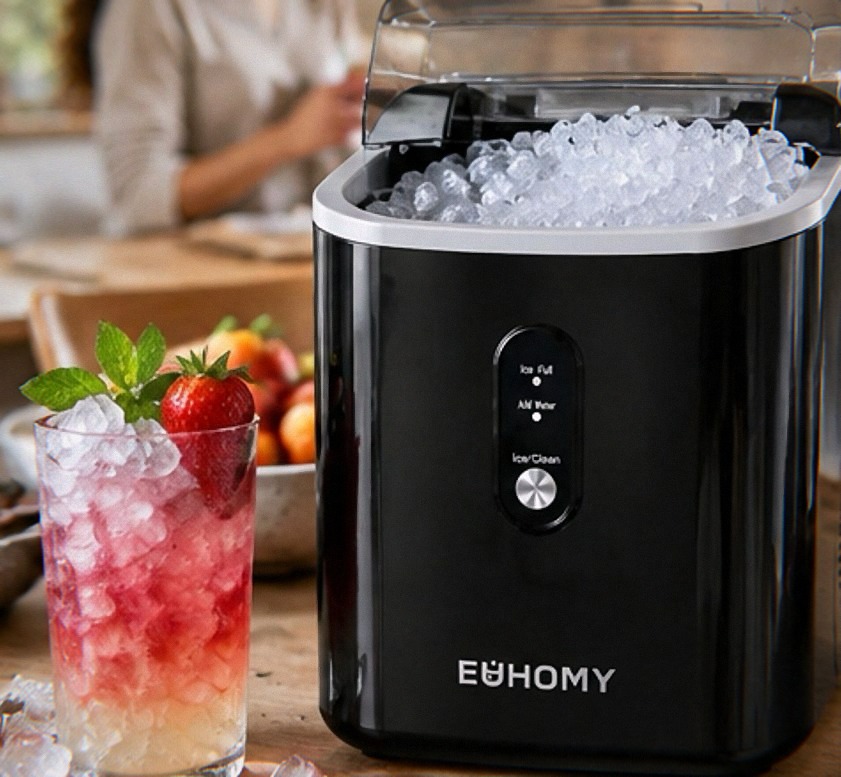
Refills Are Part of the Deal
The 1.2-quart reservoir holds about 1.14 liters of water. Ice is mostly water by weight, so the small tank—not merely the compressor—sets the rhythm of ownership. A household making several large drinks will meet the ADD WATER indicator often enough that keeping a jug nearby is more useful than admiring the one-touch control panel.
The controls themselves are mercifully simple. There is no app to reconnect after a router change and no voice assistant required to ask for ice. If connected controls are high on your list, the Silonn 44 lb nugget ice maker with app and voice control takes a different approach; the EUHOMY keeps the interaction physical and immediate. For a machine whose main jobs are freezing water and requesting a refill, that restraint is sensible.
Will the EUHOMY Fit Beside a Coffee Maker?
At 11.61 inches deep, 9.45 inches wide, and 12.99 inches high, the housing occupies about 110 square inches of countertop before you allow working room around it. Its narrow width helps beside a sink or coffee station, but depth is usually the awkward measurement on apartment counters. Measure the clear space rather than trusting the word compact in a product name.
The removable top also changes the clearance calculation. A machine can physically slide beneath wall cabinets and still become annoying if opening or lifting the lid requires dragging it forward every time you clean it. The viewing window is useful because you can check the basket without making that lid part of every glance.
Give the Refrigeration Hardware Breathing Room
Any compressor-driven ice maker moves heat from water into the surrounding air. Crowding ventilation openings traps warm air around the machine and makes the next batch harder to produce. A tight decorative nook looks tidy in a kitchen photo; it is a poor long-term home for refrigeration equipment.
The black housing should hide minor water spots better than bright white plastic, although the window and seams will still need wiping. Fingerprints are a smaller concern than leaving splash water around the base, where it can make a lightweight countertop appliance feel less secure when you pull the basket out.
What Chewable Nugget Ice Does to Drinks
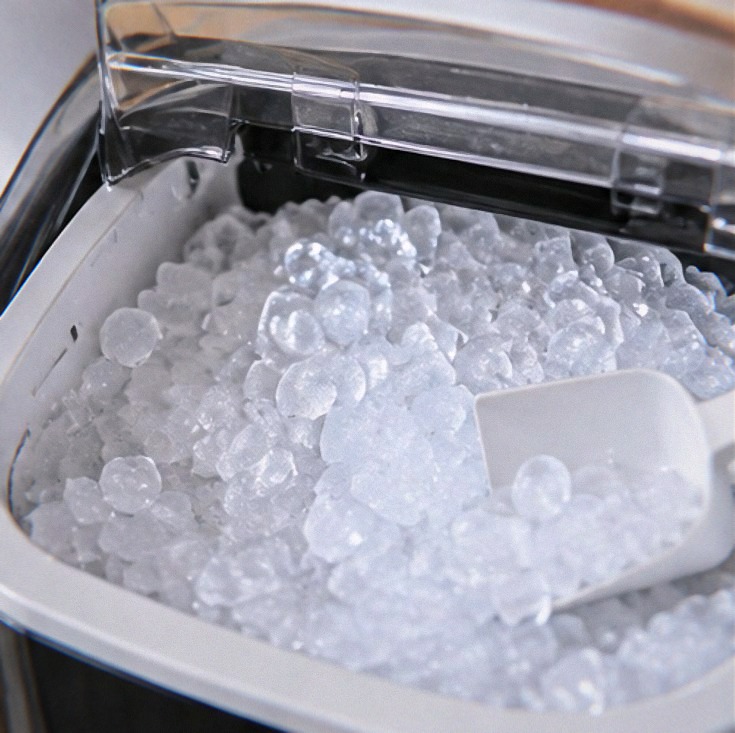
Nugget ice has tiny air pockets and an irregular structure. It breaks under your teeth more easily than a dense freezer cube, which is the entire attraction for people who chew ice or want the texture associated with restaurant pellet ice. The small pieces also pack closely around a drink instead of leaving large gaps between cubes.
That increased surface contact chills a beverage quickly, but fast cooling and slow dilution are not the same thing. Soft, wet pellets can melt faster than a large hard cube, especially in a warm room. In iced coffee or soda, the first few minutes are pleasantly cold; nurse the drink long enough and the extra water becomes noticeable. Using well-chilled coffee or a pre-cooled glass reduces how hard the ice has to work.
For smoothies and blended drinks, smaller pellets are easier to portion than prying apart a frozen block from a tray. For a slow-poured spirit where dilution control matters, this is the wrong ice shape. A machine cannot make one pellet excel at every drink.
Where the Handle Helps—and Where RV Use Gets Awkward
The built-in handle is more useful than a decorative grip because this is a wet appliance. Being able to lift from a purpose-built point beats hugging a smooth housing with damp hands when moving it from a counter to a drink table. The basket, scoop, and handle are included, so the basic setup does not depend on buying a separate serving kit.
Portable still needs qualification. The machine requires electrical power, a level operating surface, water, and time to settle after being tilted or transported. It is not an ice chest and does not keep a basket frozen on the drive to a campsite. In an RV, counter space and power capacity deserve more attention than the handle. Run it while parked and stable, then store the finished ice properly; carrying it down the road while it produces ice is asking for spills and unnecessary mechanical abuse.
For occasional parties, storing the unit between uses is reasonable only after draining and drying it. Putting away a damp reservoir and damp internal surfaces is how a convenient appliance starts smelling like the cupboard under a sink.
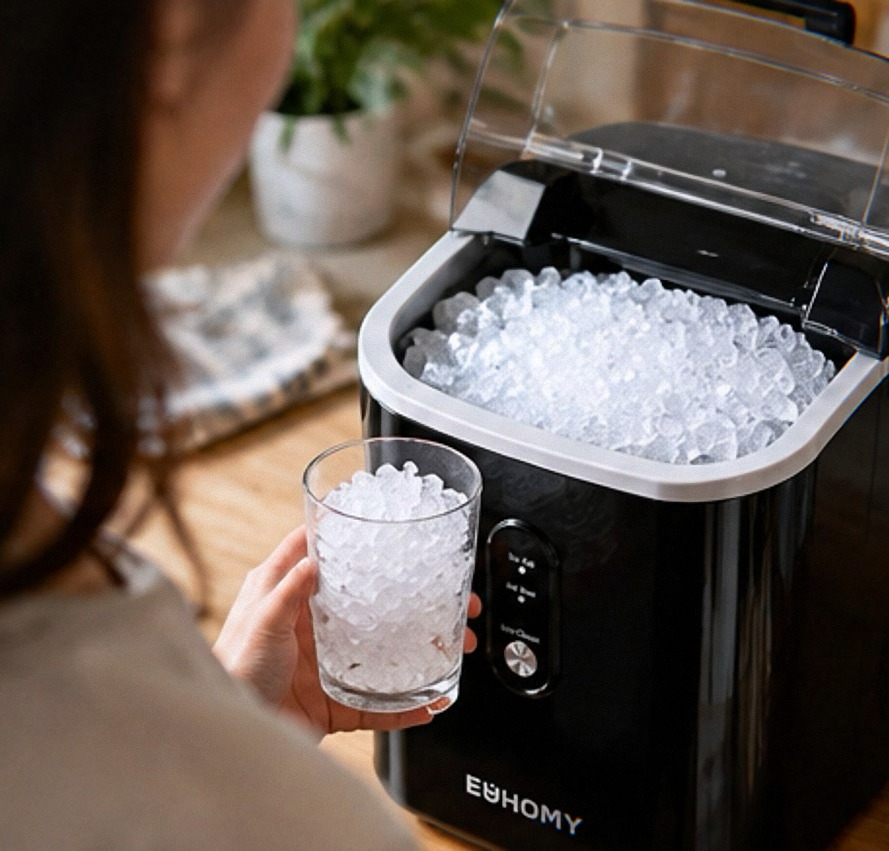
The Removable Lid Matters More Than Auto-Cleaning
One-touch auto-cleaning sounds like the machine takes care of itself. It does not. A cleaning cycle can circulate water or cleaning solution through areas you cannot conveniently reach, but it cannot replace wiping the lid, washing the basket and scoop, or removing residue from accessible corners.
The lift-up, removable top is therefore the more meaningful ownership feature. Direct access lets you see whether a damp surface is actually clean rather than trusting a timer and a blinking indicator. It also reduces the need to poke a cloth blindly around a fixed opening.
A Sensible Cleaning Routine
Empty leftover water rather than topping up yesterday’s supply indefinitely. Wash removable food-contact parts, wipe accessible surfaces, and follow the appliance manual for the cleaning solution and cycle rather than pouring in an arbitrary chemical. Rinse thoroughly afterward; ice has a talent for carrying lingering tastes into a drink.
After cleaning, leave moisture-prone areas open to air-dry when practical. The process is not technically difficult. The irritating part is frequency: buy a daily ice maker and you acquire another small appliance with a wet interior to maintain.
Hard Water Can Ruin the Easy Ownership Plan
Mineral water leaves minerals behind as water freezes, melts, and evaporates around the system. Scale does not improve the taste of ice, and buildup on wet components can interfere with the very mechanisms that should move and sense ice reliably. A self-cleaning button does not repeal basic water chemistry.
If your kettle quickly develops a hard white crust, expect this machine to need deliberate descaling too. Use the water and cleaning approach recommended in the manual, and do not assume distilled water automatically eliminates every cleaning task; it reduces mineral input, not dust, handling contamination, or damp storage.
If you are comparing straightforward countertop pellet machines, the Cowsar nugget countertop ice maker review is useful for thinking through the same daily trade-off: output numbers look generous, while basket capacity, refilling, and cleaning decide how much of that output you actually use. Bigger specifications do not remove those chores.
Is Under 45 dB Quiet Enough for an Open Kitchen?
The low-noise design target is under 45 dB, but a single number cannot tell you where the microphone was, what the room contributed, or which part of the cycle was measured. Ice making involves a compressor, moving water, airflow, and pellets dropping into a basket. Even a modest steady hum becomes obvious when the refrigerator and dishwasher are both off.
Bedroom-adjacent placement is optimistic. An open-plan apartment can live with ordinary appliance noise during the day, yet that same hum becomes the loudest thing in the room at midnight. If nighttime ice matters, make a freezer reserve earlier instead of running the machine beside someone trying to sleep.
New rattles, strained mechanical sounds, or a sharp change from its normal operating noise should not be treated as a personality quirk. Stop and inspect the setup, water level, cleaning needs, and support guidance rather than letting a refrigeration appliance grind through a problem.
Who Should Buy the EUHOMY—and Who Should Skip It
The EUHOMY makes sense for a small household that specifically wants soft pellet ice and will run the machine before drinks are needed. It fits a coffee station, a casual drinks counter, or a parked RV setup where its modest width, simple controls, removable basket, and handle are practical. The six-to-eight-minute start reduces planning without pretending that the basket is bottomless.
It also makes sense if you prefer buttons over another appliance app. Fill, start, empty, refill. That routine is the product.
Skip it if you want a large quantity of stored ice without touching the machine, if soft ice will annoy you in slowly sipped drinks, or if your available counter has no ventilation and lid-clearance room. Anyone unwilling to drain, wipe, and descale a wet appliance should skip the entire countertop nugget category rather than hoping this model is exempt.
The strongest reason to choose this EUHOMY is the ice itself. The daily figure is secondary, the portability is situational, and auto-cleaning only reduces part of the work. If chewable pellets are the feature you will use most days, those compromises are understandable. If you merely want colder drinks a few times a month, freezer trays are slower but demand much less counter space and maintenance.
Check the EUHOMY Nugget Ice Maker on Amazon
Disclosure: If you buy through the Amazon link above, this site may earn an affiliate commission at no additional cost to you.
Disclaimer: Prices and availability are accurate as of the date indicated and are subject to change. Any price and availability information displayed on Amazon at the time of purchase will apply to the purchase of this product.